
Debris netting does one job — keep tools and loose material from falling on people below. But it only works if it's fixed to hold against wind, and specified to the rules. Here's what a safe installation actually requires.

Debris netting is the vertical mesh fixed to the outside face of scaffolding to contain dropped tools, offcuts and loose material — and, just as importantly, to keep a public footpath under a job safe. It is not a fall-arrest system and it is not a substitute for toe boards and guardrails, but it is a required layer on most occupied sites. The mistakes that cause failures are rarely about the net itself; they’re about wind load and fixings. Here’s how to spec and install it properly.
Scaffolding debris netting is a lightweight, knitted or woven mesh, typically flame-retardant HDPE, with reinforced eyelets along each edge. It catches small falling objects and stops loose material blowing off the deck, while still letting light and air through so the scaffold doesn’t become a sail. What it does not do is stop a person falling, or hold a heavy concentrated load. Those are separate systems, and a net pressed into that role will fail. Specify debris netting for what it is: a containment and windbreak layer, sized and tied to the standards for your region.
A netted scaffold face is a large surface, and wind turns that surface into a force. The netting, its ties and the scaffold behind it must all be sized for the wind load the site will actually see — not the calm-day assumption. This is why fixings are the point of failure most inspectors look for first. In simple terms:
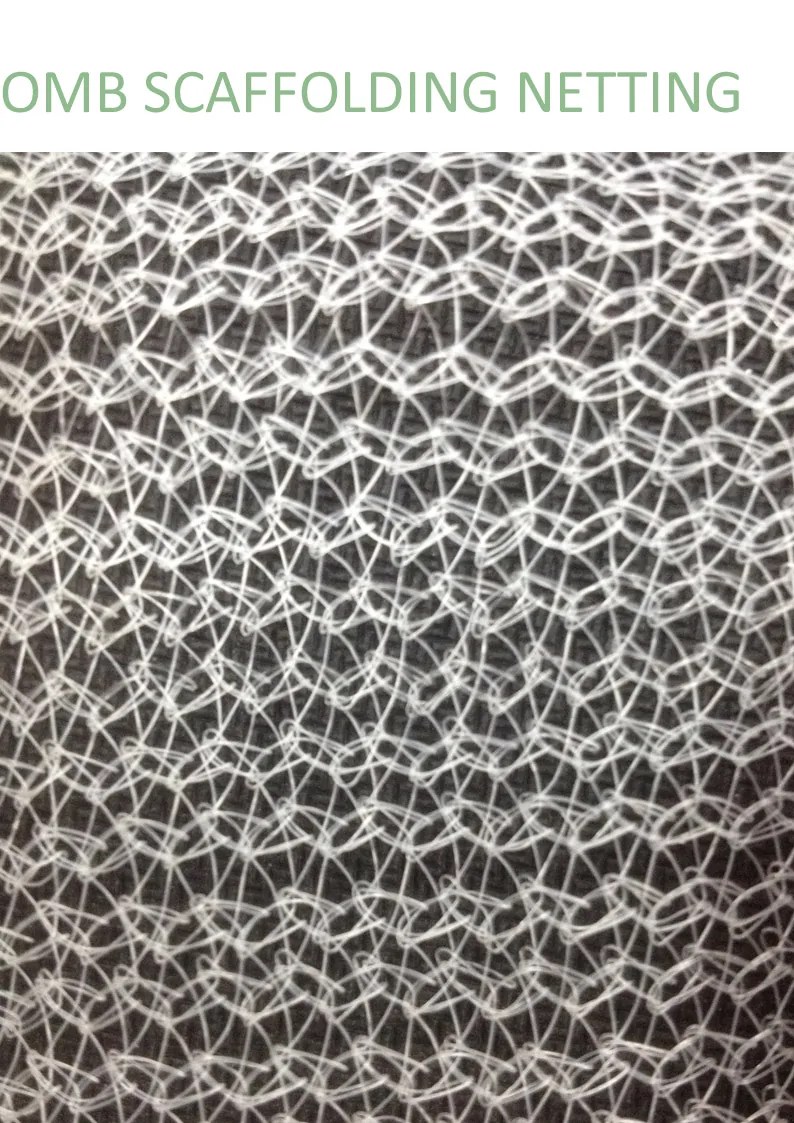
Get the fixing pattern right and the net stays put through storms. Tie every eyelet line — top, centre and bottom — not just the corners, and keep tie spacing around one per square metre. Over-spacing the ties is the classic failure: the net holds at the corners, the middle balloons in the wind, and the fabric rips at the eyelets. Use cable ties rated for UV and heat, and notify the scaffold contractor before you attach anything, so the added wind area is recorded in the scaffold’s design.
Where the spec calls for it, debris netting should be flame retardant — certified to a standard such as NFPA 701 — so a spark or hot work doesn’t turn the scaffold face into a fire path. Mesh openings are typically capped at 13 mm (about 1/2″) vertically and horizontally, and 19 mm (3/4″) in other dimensions, so small tools and material can’t slip through. Ask your supplier for the test certificates before the net goes up; an uncertified net that “looks the same” won’t pass an inspection.
Debris netting is a wind load, and wind loads scale with weather. In severe weather, secure or remove the netting ahead of the storm, and suspend lifting operations in high wind — crane work typically pauses around 30 mph, hoists at 30–35 mph, unless the manufacturer states otherwise. After the storm passes, re-tension and re-check every fixing before work resumes. A site that treats netting as “fit and forget” is the site that finds it wrapped around the next street over after a gale.
Need netting sized and certified for your scaffold? Tell us the scaffold face area, height and wind exposure and we will supply debris netting cut and eyeletted to your run.
For more, see our debris netting specifications and construction safety net guide.
| Product | Opening | Job |
|---|---|---|
| Debris net (flame-retardant) | 13 mm | Contain tools and debris |
| Fine debris net | 8 mm | Stop small fragments and dust |
| Fall-arrest safety net | 19 mm | Arrest a falling person (separate rating) |
Typically 13 mm (about 1/2″) openings vertically and horizontally, and up to 19 mm (3/4″) in other directions — small enough to stop dropped tools and loose material, but open enough to stay light in wind.
Where fire risk is foreseeable, yes — certified flame-retardant netting (such as NFPA 701) is required. Confirm the requirement for your site and keep the test certificate on file.
Tie every eyelet line — top, centre and bottom — with UV-stabilised ties of at least 4.8 mm, spaced no more than about one per square metre, so wind is spread across the whole face.
No. It contains debris and loose material; it does not stop a fall. Guardrails, toe boards and personal fall protection are separate and must remain in place.
Spec debris netting for wind load and fixings, not just containment: flame-retardant 13 mm mesh, tied at every eyelet line about one per square metre, and inspected after every storm. Send us your scaffold dimensions and we will quote debris netting cut to your run.
Quick Inquiry
Tell us the product and requirement — we reply within 24 hours.
Prefer WhatsApp? +86 152 6119 9768
Related Products