
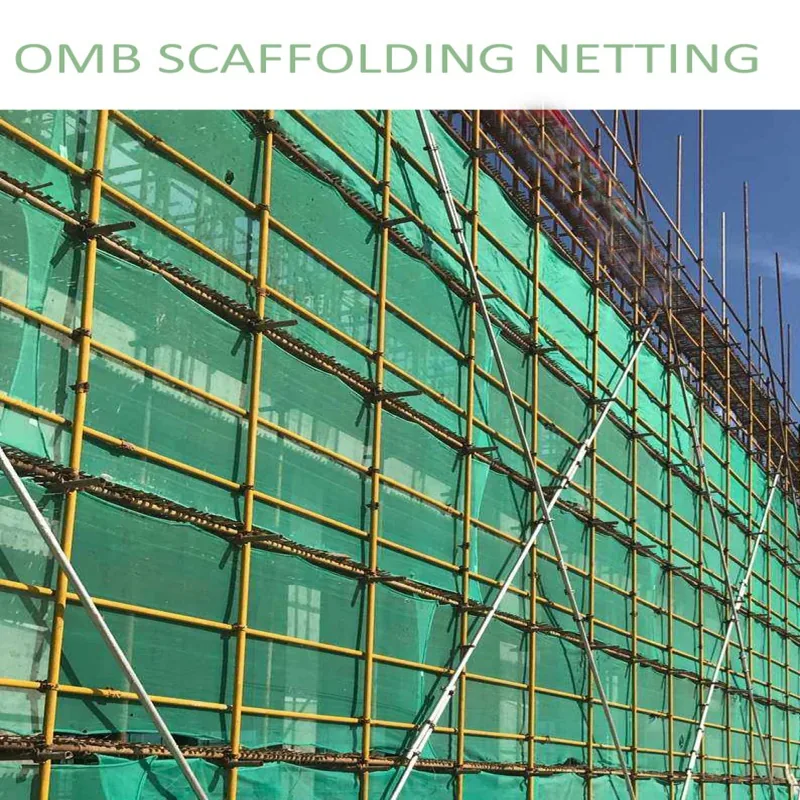
Construction debris netting is one of the most heavily regulated netting products — and one of the most frequently specified wrong. The difference between a compliant net and a failed one can be a safety inspector's report, a site shutdown, or a falling object injury. The spec matters legally, not just practically.
In most jurisdictions, debris netting on scaffolding must meet EN 12641 (Europe), OSHA 1926.451 (USA) or equivalent local standards. These set minimum requirements for mesh size, tensile strength, flame retardancy and UV resistance. A net that looks identical to a compliant one in a photo can fail on every single one of those criteria — which is why standards compliance is not optional and why "looks the same" is not a spec.
The primary function of debris netting is to retain falling objects — small tools, material fragments, dust — so they do not hit workers or passers-by below. EN 12641 Class A requires a maximum aperture of 3 mm and flame retardancy; Class B allows up to 10 mm aperture. For general construction debris, a mesh of 2–5 mm is the practical working range — fine enough to stop tools and fragments, open enough that wind load does not turn the net into a sail.
Debris netting on scaffolding faces significant wind load, especially on tall buildings and in exposed sites. The net must have sufficient tensile strength to absorb the wind load without tearing or pulling the fixings loose. Flame retardancy is required on most public-facing sites (EN 12641 Class A, B1 per DIN 4102, or equivalent) — a non-flame-retardant net on an occupied site or near a works area is a liability. We supply flame-retardant treated HDPE debris netting that meets EN 12641 Class A.
| Requirement | EN 12641 Class A/B | OSHA 1926.451 |
|---|---|---|
| Mesh aperture | 3 mm (Class A) / 10 mm (Class B) | Not specified, must retain debris |
| Flame retardancy | Required (Class A mandatory) | Required in certain applications |
| UV resistance | Required for outdoor use | Recommended |
| Marking | CE marking required | Manufacturer's declaration |
It is important to distinguish debris netting (which catches falling objects and debris) from safety netting (which is load-rated to arrest a person falling). Debris netting is lighter, has a finer mesh, and is not rated for human arrest. Safety netting to EN 363 or equivalent is a different product with a different test and a different price. Confusing the two on a specification is a serious safety and compliance error — our scaffolding net page covers both products and their different ratings.
Debris netting is fixed to the scaffolding scaffold tubes with cable ties or net clips at intervals of 15–30 cm along every support. The net must be continuous — no gaps at joints, corners or where different net widths meet. Inspect before every working day on occupied sites, and after every significant wind event. Replace any net that shows UV degradation, flame retardant washout or damage at fixing points. Tell us your scaffolding height, bay width and local standard and we will supply the correct class and fixing specification.
EN 12641 in Europe (Class A for flame retardant, Class B for standard), OSHA 1926.451 in the USA. Both set requirements for mesh, strength and fixing. Check your local jurisdiction for the applicable standard.
EN 12641 Class A makes flame retardancy mandatory. Even where not strictly required, flame-retardant netting is strongly recommended on sites with hot works, welding or electrical activity.
Debris netting catches falling objects and debris — it is not load-rated for human arrest. Safety netting (EN 363) is separately tested and certified to arrest a person. Using debris netting as a safety net is a serious compliance error.
Before every working day on occupied or public-facing sites, and after every significant wind event. Replace nets that show UV degradation, flame retardant washout or damage at the fixing points.
Debris netting is regulated, not commodity — match the standard to your site (EN 12641 Class A/B or OSHA), flame retardancy included. Tell us your project and we will spec the right net, GSM and size.
Related Products