

“Construction safety net” is one search term that covers three completely different products — and ordering by the name alone is how sites end up with decorative mesh where they needed debris containment, or debris mesh where a standard demanded certified fall protection. The three types look similar on a truck and are nothing alike in a specification. This guide separates them, with the specs and standards to ask for on each, so the net that arrives is the net your site actually needs.
Fall-arrest nets exist to catch people. They are life-safety equipment, and they are regulated like it: EN 1263-1 in Europe, OSHA 1926.502(c) in the United States. A compliant system means tested energy absorption, minimum mesh strength, defined sag, and documented installation by competent riggers — with test certificates to prove all of it.
Straight talk from a manufacturer: this is a certified life-safety category, and it is not what our knitted HDPE netting is for. If your project needs personnel fall protection, specify it through a specialist supplier who provides EN 1263-1 or OSHA-compliant test documentation, and never substitute debris or enclosure mesh for it — however strong it looks.
This is the green or black mesh you see wrapped around scaffolding, and it is the product most buyers mean when they search for a construction safety net. Its jobs are to contain debris, tools and materials inside the work zone, shield pedestrians below, knock down dust, and take the edge off wind-driven rain — while staying permeable enough that the scaffold does not become a sail.
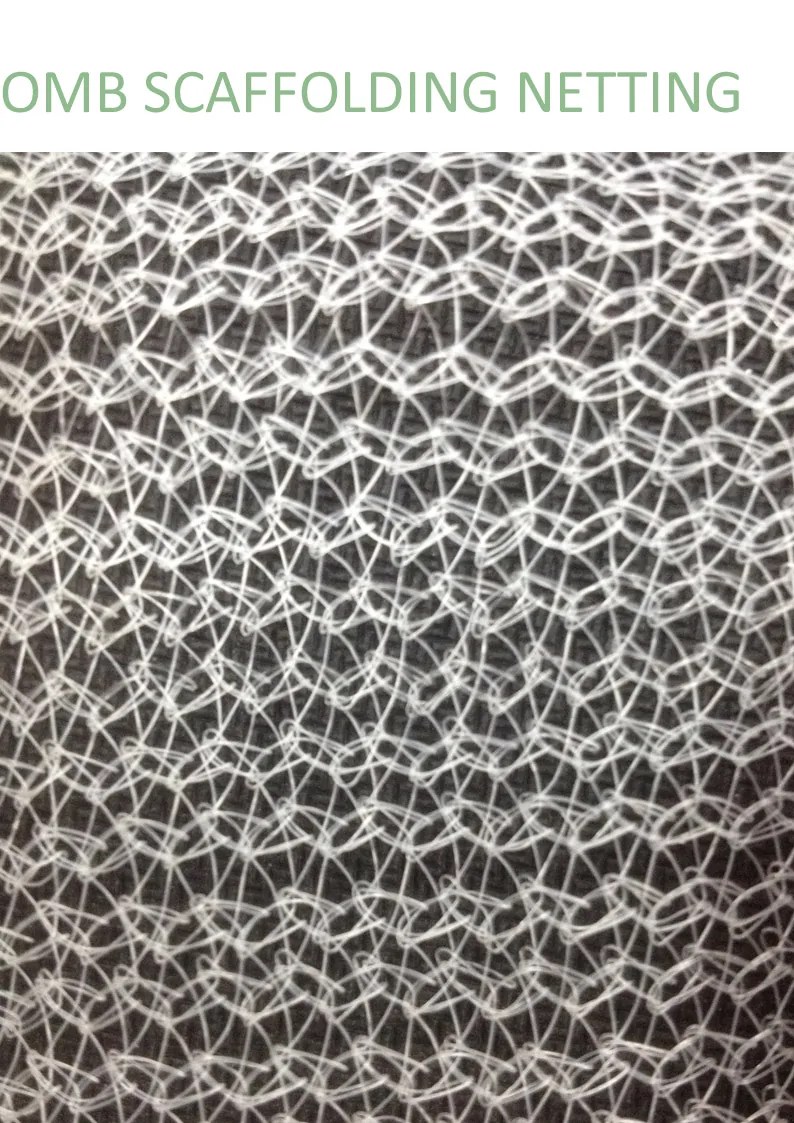
What to spec:
Installation decides whether the spec survives the weather: fix with cable ties at regular intervals to every lift, overlap sheet joints, and increase fixing density on exposed faces. Our debris netting site safety guide goes deeper into wind-load and fixing frequency.
The third product is purely visual: high-visibility orange or yellow barrier netting that marks hazards, channels pedestrians and closes off areas. It carries no load and stops nothing heavier than attention — but on a busy site that is exactly its job. Spec it at 50–120 gsm in UV-stabilized HDPE, and be honest on the purchase order about what it is: demarcation, not protection. Our barrier and warning netting covers this category.
Four errors show up on purchase orders again and again. First, ordering by color — “the green net” says nothing; two 100 gsm nets can differ wildly in tear strength and UV package. Second, under-speccing duration: a six-month wrap in a high-UV climate needs a stated UV package, or the mesh you remove is weaker than the mesh you installed. Third, ignoring wind: debris netting is permeable, not wind-proof, and a scaffold fully sheeted on all faces behaves very differently from an open one — involve your scaffold designer on exposed structures. Fourth, no spare material: sites tear netting. Order 5–10% over the measured area and repairs never wait on a shipment.
For a scaffold wrap, measure the total face area — length × height of every face to be covered — then add 10% for overlaps, fixing allowance and damage repairs. Convert to rolls from the roll size: a 4’×50′ roll covers about 18.6 m², so a 1,000 m² face area needs roughly 59 rolls with the allowance included. For barrier netting, measure the perimeter to be marked and order by linear meter with the same 10% margin. Send us the face dimensions and we will do this calculation for you and quote by the roll or by the container.
Whatever the type, a serious supplier answers these without hesitation:
Our scaffolding and construction netting is knitted in our Changzhou factory and exported to contractors and distributors worldwide:
| Material | 100% virgin HDPE with UV stabilization |
| Weight (GSM) | 85 / 90 / 100 / 110 / 120 gsm |
| Standard sizes | 4’×50′, 5’6″×150′, 8’6″×150′ — custom on request |
| Colors | Green/black, blue/white, dark green/black — high-visibility options |
| Fire performance | Flame-retardant version available on request (test report supplied) |
| MOQ | 2 tons |
| Lead time | 25–35 days after deposit |
| Payment | T/T 30% deposit + 70% balance, or 100% L/C at sight |
Send your scaffold dimensions, project duration and local fire-code requirement via the contact page or WhatsApp, and we will come back with a GSM, size and price — with the FR test report if your code requires it.
For a related angle, see our debris netting specifications.
No. Scaffold and debris netting contains materials and shields the public. A personnel safety net is certified fall-arrest equipment governed by EN 1263-1 or OSHA 1926.502(c) — a different product with test documentation. Never substitute one for the other.
85–120 gsm knitted HDPE covers most scaffold wraps. Choose the heavier end for long projects, demolition work, or exposed sites where wind load and abrasion are higher.
Increasingly, yes — many jurisdictions, insurers and main contractors require FR scaffold mesh, typically to NFPA 701 or a DIN 4102 classification. Check your local code and always ask for the test report.
With cable ties at regular intervals along every horizontal and vertical member, sheets overlapped at joints, and fixing density increased on wind-exposed faces. Re-check fixings after storms.
Decide which of the three products you actually need before you order: certified fall-arrest for people, 85–120 gsm debris netting for containment, high-vis barrier mesh for demarcation. Then get the fire and UV specs in writing. Tell us your site requirement and we will spec the right construction netting for it.
Quick Inquiry
Tell us the product and requirement — we reply within 24 hours.
Prefer WhatsApp? +86 189 1275 3505