Warning netting is a site's first line of sight — a bright, wind-permeable barrier that marks the perimeter and keeps people out. But not all netting is the same: the mesh that marks a boundary is not the mesh that catches a falling tool.

Warning netting is a site’s first line of sight — a bright, wind-permeable barrier that marks the perimeter, keeps the public out and channels workers onto safe routes. But “netting” is a loose word on a building site: the mesh that marks a boundary is not the same as the mesh that catches a falling tool. Knowing the difference is what keeps a site both legal and safe.
Barrier and warning netting is for perimeter delineation, pedestrian control and hazard marking: fencing off an excavation, a material laydown area, or a route the public must not cross. It is a visual and physical cue, not a fall-protection system.
It will not stop a falling tool or a falling person. Those jobs belong to rated debris netting and safety netting, which are engineered and tested to different standards. Confusing the two is the most common — and most dangerous — mistake we see at tender stage. A light barrier net contains dust and small debris only.
Warning netting is made in fluorescent orange or yellow for one reason: it has to be seen against grey concrete, dust and low light. Orange is the near-universal signal for hazard — general warning; bright red-and-white marks restricted or prohibited zones. Whatever color you run, it must stay bright for the life of the job, which is why UV-stabilised pigment matters.
For barriers left up after dark, add reflective tape or flashing amber lamps — colour alone is not enough once the sun goes down.
| Property | Typical spec |
|---|---|
| Material | Knitted HDPE, fluorescent orange / yellow |
| Weight | 70–120 g/m² |
| Mesh opening | ≈ 13 mm, 40–60% open area |
| Edge grommets | Brass / nickel, every 12–24 in (30–60 cm) |
| UV stabilisation | 6–12 month colourfastness |
The grommets are the weak point on cheap netting — if they tear out, the barrier sags and gaps open. Look for reinforced, metal eyelets on all four sides, not just the corners.
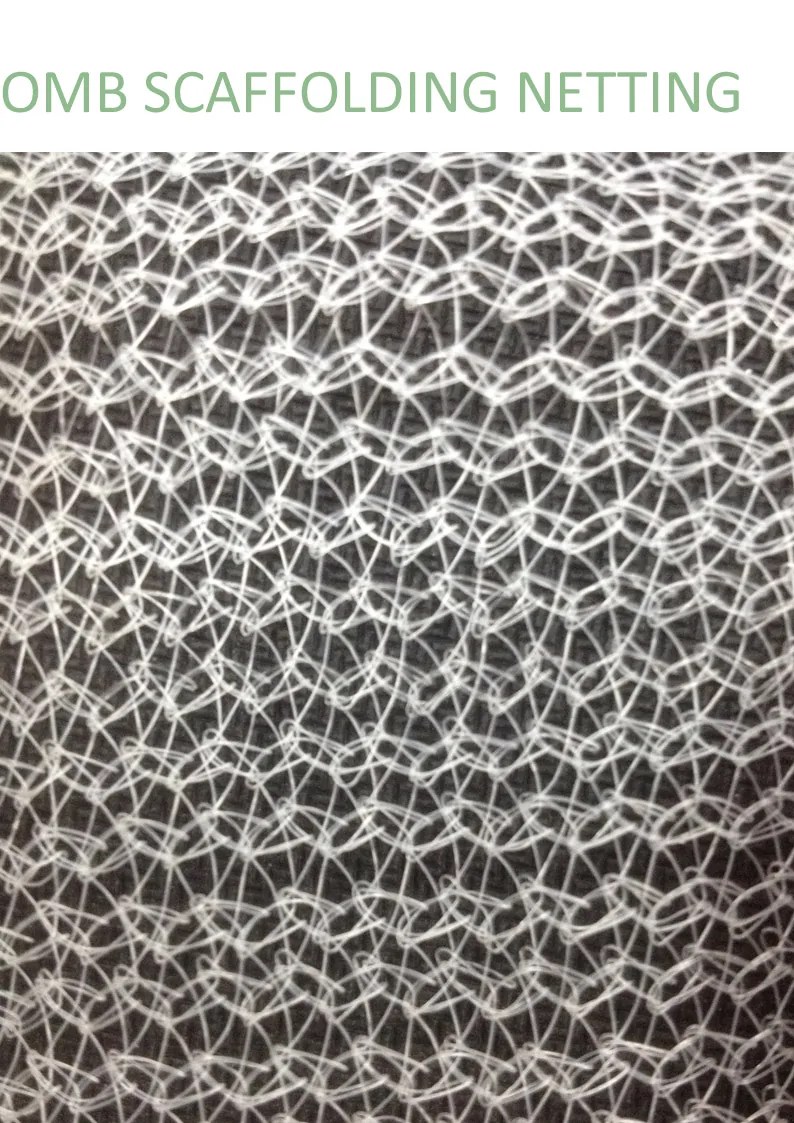
A solid tarpaulin or hoarding panel acts like a wall — wind pushes against it and the load transfers straight into the posts. Warning netting’s 40–60% open area lets air through, which cuts wind load on the fence line by 60–80% versus solid sheeting. That means lighter posts, fewer blow-overs, and a barrier that stays standing through a storm.
Where a barrier sits near sparks, welding or heat sources, specify flame-retardant mesh certified to NFPA 701 (US) or EN 13501 / BS 5867 (EU). Standard HDPE is not self-extinguishing, and on a live site that distinction is written into the spec, not optional. Note again that flame-retardant debris netting for scaffolding is a separate, more heavily tested product from perimeter warning netting.
Related: read our debris netting for scaffolding and construction safety net guide.
No. Warning / barrier netting marks a perimeter and keeps people out. Debris netting is flame-retardant, fixed to scaffolding, and engineered to catch small falling material — it is rated to different standards.
70–120 g/m² is the usual working range for a construction perimeter, with reinforced metal grommets on all four edges.
Fluorescent orange gives maximum contrast against concrete, dust and low light, and is read as a hazard signal. UV-stabilised pigment keeps it bright for the life of the job.
No. It contains dust and small debris only. Falling-tool protection requires rated debris or safety netting engineered and tested for impact.
Use warning netting to mark, channel and keep out — and rated debris netting to catch. Spec UV-stabilised mesh with reinforced grommets and flame-retardant certification where heat is present. Tell us your site and we will quote the right barrier / warning net.
Quick Inquiry
Tell us the product and requirement — we reply within 24 hours.
Bulk buyer (2 t+)? Send your spec — GSM, mesh, dimensions, quantity, destination port — and get a container-level quote, not a retail answer.
Prefer WhatsApp? +86 152 6119 9768
Related Products